
Artist Spotlight: Victor Surbrook
How about we start with you telling me a little bit about yourself and your background?
I've kind of always been an artist. My mom went to Moore for interior design, so she was very heavily involved in that space, and that was a big part of my childhood. Throughout the rest of my life that influence continued. From 2021 to 2023, I attended the Delaware College of Art and Design, a two-year school in Wilmington, Delaware, which is where I'm from. I got my associate’s degree there and then transferred to PAFA, where I finished my bachelor’s degree. Right now, I’m doing one of the certificate programs, so I still have a studio here and I’m still taking classes. I’m just now getting to the phase of moving out of being a student artist and trying to build more of a professional career.
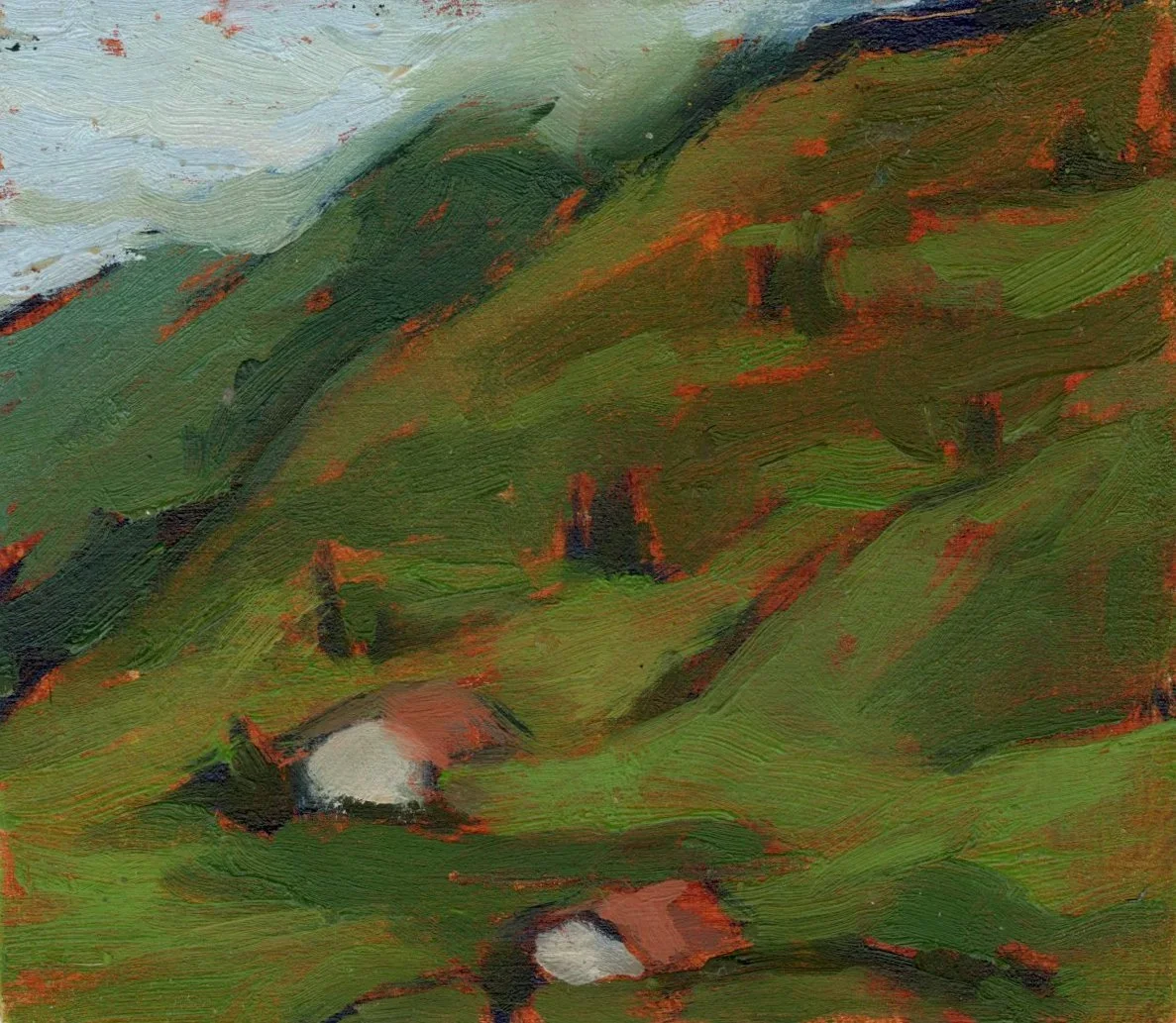
Victor Surbrook, Far-off Mountain, oil on panel, 3.5"x3"
How would you describe your artistic voice right now, and how has it evolved over time?
The main things I’m focused on are primarily landscape works, the nude figure, and interior spaces. Across all of those, my main focus is on natural beauty and a sense of intimacy with the subject portraying someone in a vulnerable space while still allowing them to feel safe and comfortable within the fiction of the image. Over the past couple of years in school, my work has definitely changed a lot. Earlier on, so much time was spent on technique and building a solid base of skill. Only recently do I feel like I’ve moved more into trying to describe something deeper trying to convey an emotion, a memory, or a scene rather than focusing solely on technical skill.
Your work often blends observation, memory, and imagination. What draws you to that mix?
A lot of the things I’m interested in right now are a mixture of observation and imagination. I think that comes from the desire to represent something real, but in an altered way. It’s not just an observation of something; it’s like looking at a scene or an image through the lens of a memory, or as something slightly abstracted. It’s not quite as literal, and there’s more room for interpretation.
Are there any emotions or themes that you find yourself returning to again and again?
I’m really interested in exploring vulnerability and intimacy, both between figures in a scene and between the subject and the viewer. A lot of my figurative work is of nude figures, which inherently has an intimate quality. Much of the work features a single nude figure in an imagined space. I also like playing with the sense of a very private, intimate moment and the relationship that creates with the viewer, which can feel voyeuristic. The pieces I’m doing through Ministry of Awe are a series of sleeping figures different people in very vulnerable, intimate positions, captured in a way that the viewer can observe, almost like a family photograph.
Can you walk me through your creative process from initial idea to finished piece?
My process can be a bit all over the place. Sometimes it’s planned, and sometimes it’s more spontaneous. For this commission work, it had to be more structured because I needed approval at different stages. I started by making thumbnails and small concept sketches to explore basic ideas. I narrowed those down and then created full-size pencil sketches. Once the drawings were finished, I sealed them so I could paint oil on top. That’s a process I’m continuing to develop because I want the drawing to show through while still being colorized.
What do you hope a viewer thinks or feels when they first interact with your art?
That’s a hard question because so much of my work is for myself rather than a final viewer. Ultimately, I enjoy putting something into the world and letting people take what they take from it. For these pieces, I hope there’s a feeling of closeness of knowing these people, or recognizing yourself in them and seeing it as a calm, intimate moment between the figure and the viewer.
What have you learned from exhibiting your work publicly, particularly in the Philly art scene?
It’s intimidating to move into that world because it’s easy to compare yourself to others. That said, every opportunity I’ve had in Philly I’ve been incredibly grateful for. Everyone I’ve worked with has been kind and encouraging. A lot of what I’ve learned has been internal trying not to compare myself and learning to feel confident about my work, even when it’s not as good as I wish it were.
How did working on large-scale projects, like murals, change the way you think about your art?
Those projects helped me see a future beyond just being in school and painting for a class. They gave me a glimpse of what it could look like to actually do this for work and continue it long-term, which has been really encouraging.
Who are some of your biggest artistic influences right now?
Some of the artists whose influence is most visible in my work include John Singer Sargent, Matisse, Andrew Wyeth, and Kuka. I’ve also been looking at a lot of American landscape painters recently.
Looking ahead, what directions or challenges are you most excited to explore?
This next year is going to be challenging as I move out of the student mindset. I’m figuring out how to balance a day job with an art career and how to maintain a studio practice without classes. It’s intimidating, but also really exciting.
What do you find awe-inspiring?
I’m very drawn to simple, natural beauty being outside, being in natural spaces, and appreciating small, everyday moments. Relationships with other people, sitting in the world with them, and seeing their perspectives are what I find most awe-inspiring right now.